What is the difference between different airflow cleanroom?
Category:
Published Time:
2023-10-21
The purification principle of unidirectional airflow is the piston and compression principle, which compresses dust from one end to the other and replaces polluted airflow with clean airflow. This includes both vertical unidirectional flow and horizontal unidirectional flow.
Vertical unidirectional flow is the airflow pattern that flows from the ceiling to the floor at a certain speed (0.25m/s~0.5m/s). This airflow can create cleanliness levels of 100, 10, 1, or higher. But its initial investment is high and the operating cost is high. In the project, try to minimize its area and use necessary parts.
Horizontal unidirectional flow is the airflow pattern where the airflow flows from one wall to the opposite wall at a certain speed (0.3m/s~0.5m/s). This airflow can create a purification level of 100 levels. Its initial investment and operating costs are lower than those of vertical unidirectional flow patterns.
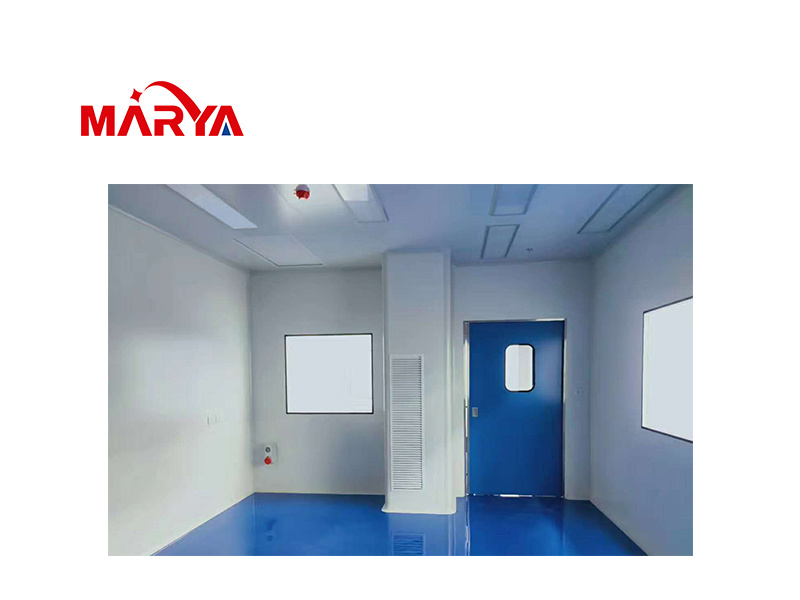
1. Non unidirectional flow cleanroom:
The airflow pattern of non unidirectional flow cleanrooms can be divided into top supply and bottom return; Top feeding lower side return; Top feeding, top returning, etc.
The purification principle of non unidirectional airflow is the dilution principle. The general type is high-efficiency filter air supply outlet with top air supply; The types of return air include lower return air, side lower return air, and top return air. Depending on the frequency of air supply and exchange, achieving different purification levels results in different initial investment and operating costs.
Mixed flow clean room: Mixed flow airflow is an airflow flow pattern that combines vertical unidirectional flow and non unidirectional flow. The characteristic of this airflow is to compress the area of vertical unidirectional flow to the minimum, and replace large unidirectional flow with large non unidirectional flow to save initial investment and operating costs.

2. Vector flow (diagonal flow) cleanroom:
Select the airflow flow pattern of the upper arc high-efficiency filter air outlet for air supply and the lower return air outlet for air return on the opposite side.
The airflow in the vector flow cleanroom flows out in a radial flow line, with no vertical intersection between the flow lines. A relatively small amount of air supply can be used to achieve a higher level of cleanliness. It is commonly used in small clean rooms in industries such as medicine, healthcare, and electronics. It is also widely used in certain special laboratories.
According to the main control objects of clean rooms, they can also be divided into: industrial clean rooms; Biological cleanroom.

3. Industrial Cleanroom:
The main control object of industrial cleanrooms is dust particles (regardless of whether they are living or inanimate).
Industrial cleanrooms are mainly used in industries such as electronics, aerospace, aviation, machinery, chemical engineering, chemical pharmaceuticals, energy, and nanotechnology. Especially in the electronics and optoelectronics industries, clean rooms and clean technology are indispensable.

4. Biological Cleanroom:
The main control objects of biological cleanrooms are living and living microbial particles, such as bacteria, viruses, and other particles that are harmful to humans, animals, and the environment.
Biological cleanrooms are widely used in medical (clean operating rooms, clean wards), biopharmaceuticals, laboratory animal husbandry, biosafety laboratories, and health and epidemic prevention and quarantine industries. The development speed of biological clean rooms is very fast and has been recognized and valued by all parties.
Keyword:
Previous Page:
: Next Page
CONTACT
Factory: No. 326 Linyu Road, Yuelu District, Changsha, Hunan, China
Shanghai Office: NO211, North Fute Road, Pudong area, Shanghai, China, 200131
Hong Kong Office: 12/F, Cosco Tower, No.183 Queen's Road Central, Sheung Wan, Hong Kong